
Friday, October 16, 2009


Thursday, October 01, 2009
High Altitude Training
So this is a first for my blog despite the fact that I have been writing it on and off for more than four years now. A post about Hawaii!
 Sunrise from the Onizuka Visitor Center.
My next mission for work is to the eastern foothills of the Himalayas in India (more about that in a future post). As a result some of us who are going on the mission were sent out to the Big Island of Hawaii for training in basic climbing/mountaineering techniques and high altitude conditioning.
 Lodging at PTA
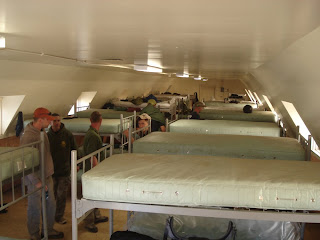 The inside of the lodging.
We flew out to the Big Island last Thursday and drove up to the Pohakuloa Training Area, an army installation in the saddle between Mauna Kea and Mauna Loa at about 6000'. We spent Thursday afternoon and all day Friday going over basic climbing techniques including knots, ascending a fixed line, rappelling, belaying, etc... In the evenings were had classes on altitude induced illnesses. We also went out for two short hikes.

Saturday morning we drove up to the Onizuka Visitor Center located at about 9300'. Over the course of Saturday and Sunday we practiced steep earth patient movement, or how to move an injured person on tough terrain. We also completed two more hikes that were slightly harder than the first couple.
Most tourists to the big island simply drive from their resorts at sea level up to the visitors' center, wait an hour, and then drive to the top of Mauna Kea. The point of us spending four days acclimatizing was that we were planning on hiking from 9300' at Onizuka to 13796' at the top. The extra waiting time and short hikes allowed us to stack red blood cells, which carry oxygen. Experienced mountaineers are probably thinking "four days is way too many in that situation". Please remember that I work for the U.S. military, for which safety is always the number one concern.
So at 7:00 on Monday, 28 September 2009 eleven guys set out to hike the Humu`ula trail to the top of Mauna Kea.
 Long shadows of early morning
 Looking south to Mauna Loa.
 Lots of lava field that had to be crossed.
 Big O, still going strong.

Northeast view from the top.
 Sunrise from the Onizuka Visitor Center.
My next mission for work is to the eastern foothills of the Himalayas in India (more about that in a future post). As a result some of us who are going on the mission were sent out to the Big Island of Hawaii for training in basic climbing/mountaineering techniques and high altitude conditioning.
 Lodging at PTA
 The inside of the lodging.
We flew out to the Big Island last Thursday and drove up to the Pohakuloa Training Area, an army installation in the saddle between Mauna Kea and Mauna Loa at about 6000'. We spent Thursday afternoon and all day Friday going over basic climbing techniques including knots, ascending a fixed line, rappelling, belaying, etc... In the evenings were had classes on altitude induced illnesses. We also went out for two short hikes.

Tying knots on the rope corral.
Saturday morning we drove up to the Onizuka Visitor Center located at about 9300'. Over the course of Saturday and Sunday we practiced steep earth patient movement, or how to move an injured person on tough terrain. We also completed two more hikes that were slightly harder than the first couple.
Most tourists to the big island simply drive from their resorts at sea level up to the visitors' center, wait an hour, and then drive to the top of Mauna Kea. The point of us spending four days acclimatizing was that we were planning on hiking from 9300' at Onizuka to 13796' at the top. The extra waiting time and short hikes allowed us to stack red blood cells, which carry oxygen. Experienced mountaineers are probably thinking "four days is way too many in that situation". Please remember that I work for the U.S. military, for which safety is always the number one concern.
So at 7:00 on Monday, 28 September 2009 eleven guys set out to hike the Humu`ula trail to the top of Mauna Kea.
 Long shadows of early morning
 Looking south to Mauna Loa.
 Lots of lava field that had to be crossed.
 Big O, still going strong.
Almost there...
 U.S.G.S survey marker.
 Hikers at the top.
 U.S.G.S survey marker.
 Hikers at the top.
Northeast view from the top.
The hike was tough, but there were no technical sections. It was a long slow hike across about 7 miles of shadeless lava fields. Aside from the practical skills I learned three very important things. First, I am going to be able to handle the altitude in India. Second, I will have to take my foot off of the accelerator when it comes to the pace of excavation. I usually like to run my sites at 100 mph, but I am going to have to dial it back. Third, mental abilities are hampered due to altitude. Simple word games and basic multiplication that would normally be very easy at sea level are very hard when their is not much oxygen. This translates to me needing to take more time with my notes and evidence collection in the field.
Saturday, August 01, 2009
Monday, June 29, 2009
A Few Pictures

If the line hadn't been so long I would have tried out...

 A pond full of koi at the bird park in Kuala Lumpur.
The panel outside of a set of elevator in a mall in Kuala Lumpur.
Friday, June 26, 2009
Uh...
...yeah.
 I encountered this in a freeway rest stop parking lot north of Kuala Lumpur on my way to the elephant sanctuary. The driver stopped to fix his licence plate. The vehicle clearly did not look new, but it purred like a charm when he started it up and drove off though. The driver sat in the chair, which did not appear to be physically attached to the vehicle in any way; without a seatbelt of course.

 I encountered this in a freeway rest stop parking lot north of Kuala Lumpur on my way to the elephant sanctuary. The driver stopped to fix his licence plate. The vehicle clearly did not look new, but it purred like a charm when he started it up and drove off though. The driver sat in the chair, which did not appear to be physically attached to the vehicle in any way; without a seatbelt of course.
Wednesday, June 24, 2009
Ko Phi Phi
I dropped off of the radar for a little while because I spent a week on Ko Phi Phi Don, a gorgeous tropical island off the western coast of the Thailand half-way between Phuket and Krabi. The small town on the island has been rebuilt since it was completely destroyed by the tsunami several years ago.
Ko Phi Phi (pronounced pee pee) Don is most well known for its towering limestone karst topography and scuba diving, of which I did a lot. And no, I don't have any underwater pictures. Instead you are just going to have to suffer through several tropical island photos.

The island is made up of two north-south oriented ridges with a narrow isthmus connecting them. The compact, crowded and very busy town sits on the isthmus. There are no cars on the island and only the police have scooters. The lack of city noise is blissful.
Most days I would get up at 7, stumble my way to the dive shop and head out on their boat to Ko Phi Phi Ley, a smaller island just to the south. This is the island that has May Bay where The Beach was filmed. The diving was amazing. I saw a couple different types of sharks, a sea snake, thousands of fish, and even a hawksbill turtle with a giant snail riding on its back.
 The southern most tip of Phi Phi Don with Phi Phi Ley in the distance.

 There is a short hike up to a viewpoint where you can view wonderful sunsets.

Ko Phi Phi (pronounced pee pee) Don is most well known for its towering limestone karst topography and scuba diving, of which I did a lot. And no, I don't have any underwater pictures. Instead you are just going to have to suffer through several tropical island photos.

Looking north into Tonsai Bay
The island is made up of two north-south oriented ridges with a narrow isthmus connecting them. The compact, crowded and very busy town sits on the isthmus. There are no cars on the island and only the police have scooters. The lack of city noise is blissful.
Most days I would get up at 7, stumble my way to the dive shop and head out on their boat to Ko Phi Phi Ley, a smaller island just to the south. This is the island that has May Bay where The Beach was filmed. The diving was amazing. I saw a couple different types of sharks, a sea snake, thousands of fish, and even a hawksbill turtle with a giant snail riding on its back.
The southern most tip of Phi Phi Don with Phi Phi Ley in the distance.
 There is a short hike up to a viewpoint where you can view wonderful sunsets.
Tuesday, June 23, 2009

Saturday, June 13, 2009
Elephants

Based upon the recommendation of other travelers at the hotel I was staying at I booked myself onto a tour to the National Elephant Santuary about 80 km outside Kuala Lumpur. Ok, and to alleviate your concerns, this was a real elephant sanctuary that cares for injured elephants, rebailitates ones that have been treated cruelly by bad owners, and relocates ones that have been raiding crops. Because Malaysia is a poor contry they have had to develop a tourist program at the sanctuary to subsidize their budget.

I did get to ride one of the elephants and since I was one of the last to go, I got to go for a bit of a longer ride. Part of which involved going through a small river. Now, for the entire time I had been there, the elephants had behaved wonderfully. Yeah, I am sure you can see where this is going... As we crossed the stream, much to the displeasure of the mahout, the elephant decided to lie down. We both got tossed straight into the water. Completely soaked. I did mange to save camera though.
Bird Park
Having been in an urban jungle for four solid days I decided to take a respite from the concrete and so I headed to the Kuala Lumpur Bird Park. It is the largest free flight aviary in the world. It is built in a valley so the giant nets spread across the valley and down the open end. There were dozens and dozens of species that were free to move as they please. There were even several species that were breeding regularly. I have included a few of the better photos.
 It was nice to wander around the relatively empty park and enjoy a stroll.
 The ostrich was very curious and would come right up the fence and stare at you.

 So was the hornbill. As soon as I walked up it hopped right off of its perch and came straight towards me. I was glad that it was in its own cage.
 It was nice to wander around the relatively empty park and enjoy a stroll.
 The ostrich was very curious and would come right up the fence and stare at you.
 So was the hornbill. As soon as I walked up it hopped right off of its perch and came straight towards me. I was glad that it was in its own cage.
Friday, June 12, 2009
Kuala Lumpur
After four days in Singapore I flew to Kuala Lumpur (KL). Last time when I was in SE Asia I took the bus a lot because I had quit my job and did not have a lot of money. This time around I do have a job and can now afford the pleasure of flying what would otherwise be a 6-8 hour bus ride.
I stayed at the Classic Inn in the Golden Triangle. It is a great budget hotel and I highly recommend it. Adrian and Michelle were extremely helpful and hospitable. The even invited myself and two Canadian guys out to massages and dinner with them.


 The buildings are the home of the national energy company and are built with strict geometry in mind in order to be harmonious in both Islam and Buddhist religions. I did go up to the sky bridge (they don't let you go all the way to the top of either tower).

I stayed at the Classic Inn in the Golden Triangle. It is a great budget hotel and I highly recommend it. Adrian and Michelle were extremely helpful and hospitable. The even invited myself and two Canadian guys out to massages and dinner with them.
Anyway... On to the sights.
The Petronas Towers. Ok, so here is a very interesting tidbit. Everyone in KL refers to them as the twin towers. This is perfectly normal and they say it constantly without a second thought. As an American it was very interesting to here the term "twin towers" used in a very similar yet different context. While the term refers to buildings in each case, when I first heard a Malaysian say twin towers the first that popped into my head was obviously 9/11. It took me a second or two to realize that the phrase twin towers does not automatically recall a tragedy in the mind of Malaysians.
Bigger point: Once again I have found another example of the faulty logic of the "America at the enter of the universe" mentality.
Alright, enough personal introspection.
The buildings are the home of the national energy company and are built with strict geometry in mind in order to be harmonious in both Islam and Buddhist religions. I did go up to the sky bridge (they don't let you go all the way to the top of either tower).Thursday, June 11, 2009
Moped
 I wandered upon this great old vespa on Busorah Street right in from of the Sultan Mosque in Singapore.
Saturday, June 06, 2009
Eating your way across a city
While most people know Singapore and the place where you can't chew gum or spit on the street without getting fined, it is has been a cross roads of an entire hemisphere for centuries. As a result, there is a wonderful blend of cultures. One of the foremost of these conflations is food.
Back in the 70s the government removed all of the food vendors from the streets and put them into food courts and hawker stalls. This decluttered the streets and also allowed for health and safety inspections. The result: incredible street style culinary delights where you do not have to worry about the nasty little buggies that typically come with street food in other countries in this part of the world. Needless to say I have been eating. A lot.
Laksa: A spicy curry soup with noodles, bean sprouts, fried tofu and in my case, fish. It is served in a metal bowl on the metal stand that has a fire lit underneath it. Wonderful dish. Rich, creamy, and full of flavor. I topped my meal off with mango juice.


Chicken Rice: I used makansutra to find what is supposedly the very place in all of Singapore for this dish. It is steamed chicken with an Asian style gravy that is served with a special kind of long grain rice, a bowl of chicken broth and a spicy chili paste. The chicken is steamed so perfectly that it is very soft, but not so soft that it completely falls off the bone. I have no idea what is in the gravy, but it is good. The chili paste is chili, garlic, ginger and a little water to make it not so thick. It also had a bit of a sweet edge to it that mitigated the heat. You ate the dish by taking some of the chicken and mixing it into the rice with a bit of the chili paste. You then took a bite with all of the components mixed together.

Other highly recommended dishes by the website above are chili crab, pepper crab, and fish head soup...
Back in the 70s the government removed all of the food vendors from the streets and put them into food courts and hawker stalls. This decluttered the streets and also allowed for health and safety inspections. The result: incredible street style culinary delights where you do not have to worry about the nasty little buggies that typically come with street food in other countries in this part of the world. Needless to say I have been eating. A lot.
Laksa: A spicy curry soup with noodles, bean sprouts, fried tofu and in my case, fish. It is served in a metal bowl on the metal stand that has a fire lit underneath it. Wonderful dish. Rich, creamy, and full of flavor. I topped my meal off with mango juice.


Chicken Rice: I used makansutra to find what is supposedly the very place in all of Singapore for this dish. It is steamed chicken with an Asian style gravy that is served with a special kind of long grain rice, a bowl of chicken broth and a spicy chili paste. The chicken is steamed so perfectly that it is very soft, but not so soft that it completely falls off the bone. I have no idea what is in the gravy, but it is good. The chili paste is chili, garlic, ginger and a little water to make it not so thick. It also had a bit of a sweet edge to it that mitigated the heat. You ate the dish by taking some of the chicken and mixing it into the rice with a bit of the chili paste. You then took a bite with all of the components mixed together.

Other highly recommended dishes by the website above are chili crab, pepper crab, and fish head soup...
Friday, June 05, 2009
Same Same, but Different
 This phrase is a very commonly heard idiom in SE Asia. It is said by numerous stall hawkers all over this part of the world when they want to convince you that they are selling something different from the stall right next to them.
The city/country of Singapore embodies this phrase for almost everyone who visits here. Everyone will find something that is similar to home, yet the place will be very different from home and other large cities in the region.
 Buddha Tooth Relic Temple and Museum
Like a well maintained European or American city, the streets are very clean. Maybe even cleaner than the previously mentioned places. There is a fast efficient subway, which will remind many people of home. There are also giant shopping malls. They are full of stores from major American cities like Guess, Express, Gap, and Banana Republic. They also have European heavyweights like Louis Vitton and Chanel in addition to more common ones like Boots, the British pharmacy. But unlike an American or European city the population is mostly Asian and so looks very different. There is a fairly large ex-pat community here, but they are substantially overwhelmed.
 Sultan Mosque
 Sri Veerama-kallamman Hindu Temple
Thursday, June 04, 2009
On vacation!
After another long mission in Laos the teams headed home, but I went on vacation starting in Thailand. I hopped a flight out of Bangkok this morning and I am now in Singapore. Look for more updates and pictures very soon.
Wednesday, April 29, 2009


Tuesday, April 28, 2009
Waterfall

On the same day trip that took a few of us out to Plain of Jars Site 2 we drove even farther out across the horrible dirt roads that are rural Laos and visited a waterfall. No, I don't know the name and even if I did I would probably spell it wrong anyway.


The waterfall is a series of cascading chutes, drop-offs, and pools. At least during the dry season. Through our linguist we were assured by some local farmers that during the rainy season the waterfall is a raging torrent. But we were fortunate. We got to climb amongst the multiple channels and find nice precipices upon which to enjoy the view.

Sunday, April 26, 2009
Plain of Jars, Site 2
Two years ago on my first trip to northern Laos I visited the Plain of Jars, Site 1. Site one has the most jars as well as the largest one ever made. As you would expect it is the most heavily touristed. This last trip to Laos I was in the same part of the country, but had the good fortune to get to go to Site 2.

Located much farther (down very bad dirt roads) from Phonsavan, Site 2 receives far fewer visitors. There are only about two dozen jars split between two hilltops. The first is a small cluster of jars beneath a giant tree. It is a very picturesque spot. The second hill is much more open and has numerous smaller jars.

The jars being on the hilltops is a marked difference from Site 1 where the vast majority of the jars are on a large flat area. At site 2 the very large and heavy stone jars had to have been dragged, pushed, pulled to the top of the hill.
The shape of the jars is very consistent at Site 2. They all tend to be tall a narrow with small opening. Like Site 1 it is thought that these jars were used in some form of burial practice. Recent work by Australian archaeologists has concluded that remains were not actually put into the jars, but rather buried around the jar and that the jar would have held offerings.


Located much farther (down very bad dirt roads) from Phonsavan, Site 2 receives far fewer visitors. There are only about two dozen jars split between two hilltops. The first is a small cluster of jars beneath a giant tree. It is a very picturesque spot. The second hill is much more open and has numerous smaller jars.

The jars being on the hilltops is a marked difference from Site 1 where the vast majority of the jars are on a large flat area. At site 2 the very large and heavy stone jars had to have been dragged, pushed, pulled to the top of the hill.
The shape of the jars is very consistent at Site 2. They all tend to be tall a narrow with small opening. Like Site 1 it is thought that these jars were used in some form of burial practice. Recent work by Australian archaeologists has concluded that remains were not actually put into the jars, but rather buried around the jar and that the jar would have held offerings.

Subscribe to:
Posts (Atom)
